
This commentary is adapted from remarks delivered at the 2026 National Student Support Accelerator Conference at Stanford University.
What is the most important variable in high-impact tutoring?
The humans in the school building.
Not the platform. Not the model. Not the contract.
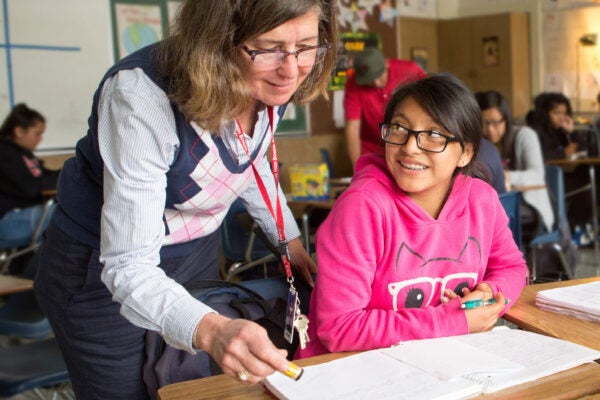
The human who makes sure a student gets to their session. The human who notices when the student isn’t progressing and asks why. The human who, on a Wednesday morning when everything else is pulling at them, still notices the quiet grimace of a student who doesn’t understand, and offers another way in.
Dosage, the amount of high-quality tutoring students receive, doesn’t just happen. Dosage is the outcome of a hundred small human decisions every single week.
It’s the instructional coach who arrives fifteen minutes early on Wednesdays to make sure every student in the virtual program has a working headset, a charged device, and a stable connection—because he’s learned the hard way that a five-minute tech glitch at the start of a session can derail the whole thing.
It’s the principal who sits down with the tutoring provider’s data every week—not just to look at aggregate numbers, but to ask: Who is flying under the radar? Who is showing up but not making progress? Where does the exit ticket data tell us something isn’t working? And then course correcting based on the answer.
They are the reason the research numbers hold, or don’t.
These seemingly small efforts are the heart of dosage—and high-dosage is the heart of academic gains. The humans in school buildings are not just delivering the intervention. They are the engine that makes the entire intervention possible.
Four years ago, I said I couldn’t imagine most struggling kids learning without a human relationship. That is still true.
AI has a role to play—as a support for tutors, a scheduling tool, and a way to reduce the operational burden on the humans in the building so they can focus on what only humans can do. But technology can make humans more effective; it cannot substitute for the human connection at the center of high-impact tutoring. Only about 5 percent of students have the self-regulation skills to engage with standalone AI tools as intended.
The human is not optional.
Susanna Loeb is a professor at Stanford University’s Graduate School of Education and founder and executive director of the National Student Support Accelerator.