
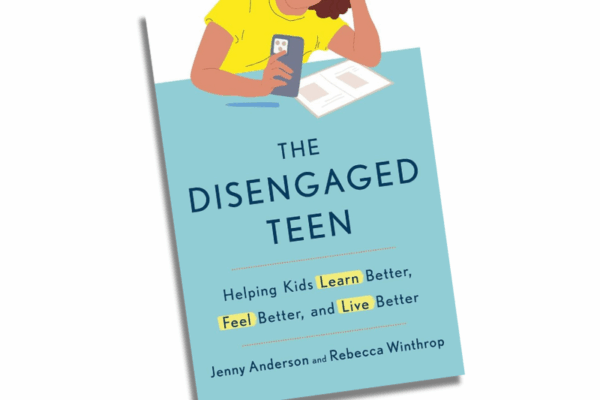
“The Disengaged Teen: Helping Kids Learn Better, Feel Better, and Live Better” by Jenny Anderson and Rebecca Winthrop examines why many students are disengaged from school today, and how parents, educators, and policymakers can reverse the troubling trend. Drawing on extensive original research and student interviews, the book outlines practical strategies to help different types of learners thrive. FutureEd Policy Analyst Tara Moon spoke with Anderson, a former financial and education reporter at The New York Times and Quartz, to explore why students lose their love of learning, why disengagement matters in an increasingly complex, technology-driven world, and what can be done to address it.
What did your research reveal about the state of student disengagement today?
It’s profound. In third grade, about 75 percent of kids say they love school, which is a validated, though not perfect proxy for engagement. By eleventh grade, only 25 percent of kids say they love school. I don’t believe that that is a developmental inevitability. Many things may happen along the way, but we have created environments that suck the joy out of learning.
Many kids are really disengaged from learning—they don’t want to put in the effort, they don’t persist with tasks. We found that over 50 percent of kids are sort of showing up, but not really learning. And we also found that only about 4 percent of middle and high schoolers have the opportunity to do things that make them feel energized, that they’re interested in, and that feel relevant to them.
Disengagement is showing up in a lot of different ways. In 2023, over a quarter of kids were chronically absent. Achievement levels have been falling off a cliff since 2010. And we are seeing adolescent mental health problems—one in five kids have a current diagnosis of anxiety, depression, or some other kind of conduct issue. In all these things, we see the impact of disengagement.
Why are so many students disengaged from school today, and how far back does this trend go?
One reason that kids are disengaged is that what they are learning is outside of their zone of proximal development, which means that school is too easy or too hard, causing them to check out. Another is neurodivergence, sometimes diagnosed, sometimes not. Additionally, relevance and interest are very important. Kids ask, “Why do I have to learn this?” And we just kind of blow it off and say, “Because you have to, because it’s on the test, because it’s just what you need to do.”
This does not mean making school less rigorous; it doesn’t mean that we need to make school entertaining with jellybeans and rainbows. I actually don’t think that’s what kids are asking for. They want school to be challenging, but accessible, and worth their time, rather than filled with mundane tasks that feel meaningless. Through their phones and the information hellscape that we all live in, they see what is happening in the outside world. And meanwhile, we’re like, “Let’s do some more algebra.” I want to be clear: algebra is important, but we also need to say, “You need to be deeply numerate so that you can understand and outsmart AI. So that you understand health stats if there is another pandemic. So that you develop reasoning and logic skills. This numeracy is preparing you for everything that comes next.”
The genre of the disengaged teen is long and storied. We all loved Ferris Bueller’s Day Off for a reason. Many fall into this idea that school sucks, and kids check out as a result of it. I think for a while that was okay because you could kind of skate by in school, maybe go to college, then you came out the other side, got a job, and everything was more or less okay. The job market enabled that. But the skills that are required of the workplace today are not only reading and writing. You need to be able to solve problems, ask questions, show initiative, and analyze data. Skill development takes time and effort and requires being engaged in learning.
Why should education policymakers pay attention to student disengagement? And what are the long-term consequences if they don’t?
I think a lot of kids associate schools as places they do not want to be, which we are seeing in chronic absenteeism. There’s a lot of evidence that since the rise of standardized testing and accountability in a limited number of academic domains, a lot of other things have gotten crowded out. We’ve said to kids today, “If you can’t do academics, you’re not successful in school”. That has turned out to be a really damaging message. We need a broader menu so that kids can turn up for many things—numeracy and literacy yes, history and civics, of course, but also drama, music, art, sports (even for the non-athletes!). If we have broader invitation into school, more ways of celebrating and recognizing intelligence and capability, and more pathways for kids, they will want to show up to school.
In terms of long-term consequences, Wendy Kopp, the founder of Teach for America, said it best: “What happens in classrooms today will show up in society in 13 years.” So, in 13 years, do you want people to be apathetic, disengaged, struggling with mental health? Or would you like curious, energized, capable people who are willing to dig in and take risks on behalf of learning? The long-term consequence of disengagement is a society that is not interested in learning or improving, a society that is not invested in each other, that is not invested in protecting democracy. And some of this we’re already seeing in misinformation, polarization, mistrust. There are other reasons for this, but clearly, engagement is a part of it. We need to be designing for engagement so that we have an engaged society, an engaged democracy, an engaged higher ed landscape, and engaged homes. We want people to care, to dig in, to stick with things, to put in the effort.
Can you define the four modes of learning you identified in the book?
The four modes are Passenger, Achiever, Resister, and Explorer.
Passenger mode is the most prevalent, representing about 50 percent of kids. These are kids who are coasting along doing the bare minimum. They are behaviorally engaged. They’re doing the work. They will raise their hand. They’ll figure out how to play the game, and they’ll play the game just enough to get through. But they’re not cognitively engaged, they’re not emotionally engaged, and they’re not agentically engaged, meaning they aren’t proactive with their own needs and interests in school.
Achievers are highly engaged. They want the 4.0s. They want the extracurriculars. They’re willing to put in the work. They are behaviorally and cognitively engaged, but they’re not emotionally engaged. They don’t actually care that much about the learning itself; they just want to collect the gold stars as they go. The challenge here is that both teachers and parents love Achievers. But these kids typically have the highest rates of mental health challenges, and they’re missing out on that component of trying to figure out who they are and what they care about. They are often fragile learners and not typically developing their own creativity.
Kids in Resister mode are dubbed the problem children, though we argue they are children with problems. They are not behaviorally, cognitively, or emotionally engaged. The good news is they are agentically engaged—they are using whatever voice they have, often in incredibly non-constructive ways, to let everybody know that things aren’t working for them, but they marshal resources around them. So, when you get them turned in the right direction, they often can take off.
Explorer mode is the peak of the engagement mountain. Explorers are curious and internally driven. They’ve figured out what they care about and how to deploy their energy and marshal the resources to get it. They are behaviorally, cognitively, emotionally, and agentically engaged.
What can educators or school districts do about the disengagement crisis?
Johnmarshall Reeve is a researcher who conducted 35 studies in 18 different countries. In all of them, he found that using autonomy-supportive practices that develop agentic engagement, like demonstrating respect and giving choice, results in kids who perform and feel better. Their graduation and attendance rates are higher, their grades are higher, their mental health problems are lower, their behavior is better. To me, the key is that anyone can do this in any classroom regardless of the sort of curriculum or constraints that a classroom might face.
There’s a huge range of what districts can do. They can do a full-blown school redesign, change timetables, organize around competencies, move beyond the college-for-all model. Broadly, we should be honoring the moment we live in, which is technological saturation, a lot of uncertainty, and a requirement for adaptability. If the world requires all those things, let’s design schools in such a way that kids can practice and start feeling they are being prepared. A huge amount of anxiety that we heard from students was that they don’t feel they’re being prepared for the world that’s on the other side, that they want to learn more practical skills. I love programs like Big Picture Learning that do an internship every single semester in high school. All of that real-life work helps kids make decisions about how to operate in the world but also gives them an understanding of why they need to be learning some of the things they are learning in the classroom.
What is the right role for technology—and smartphones in particular—in schools in supporting student engagement?
Our approach is an agency-first approach. Kids need to learn to manage the technology that is everywhere in their lives. We, at this moment, are focusing on all the legitimately damaging aspects of it, but the blanket ban of all technology doesn’t seem to reflect what young people say about how it helps them develop their interests, how they learn to be creative, and how they connect with their friends.
That said, I’m in favor of banning smartphones in schools. I think they are very distracting. The evidence seems to be that when you take them away, behavior improves. Sometimes it gets worse in the aftermath of the ban, but then it gets better, which I think is very exciting. School leaders tell me they see more conversation, more kids hanging out and talking to each other, connecting. There’s more noise, but noise is what we want in cafeterias and playgrounds! Let’s see what the data tell us on whether engagement and outcomes also improve.
AI was just emerging in classrooms when you released the book. What are your thoughts on AI and its relationship with student disengagement?
To me, the big threat is instead of putting more kids in Explorer mode, it can put more kids in Passenger or Achiever mode. It is a wonderful shortcut for the Passenger who really isn’t invested in the first place, and a wonderful way for the Achiever to get the gold star because to them, the outcomes can be the most important thing. I am very worried about parents having to play a big role from 3 pm to 11 pm, policing what kids do on screens and laptops (good luck with that).
But I’m also cautiously optimistic about how schools can use AI smartly to build agency and get kids more engaged in school—more relevance, more zone of proximal development, more coaching. Schools need to teach kids not just the how to of prompt engineering, but also the ethics of AI and how to know when to use it to stretch their thinking, to learn more about something, to test or coach themselves, and when to not use it. Teach them what it is and how it’s constructed. And that will require practice and it will be super messy, but that’s the point of a classroom. The outcomes shouldn’t be measured such that it’s right or wrong, but with an understanding that this is a lifelong process of learning how to use this technology.
If you could wave a magic wand and make a change to address disengagement, what would that be?
It would be to give choice and agency to kids for a scaffolded period. So, in ninth grade give them 10 percent choice in their learning, in tenth grade give them 25 percent choice, in eleventh grade, 50 percent choice, and then 75 percent choice in twelfth grade. These aren’t scientific—it’s just a way of saying, as kids learn more and grow, they will want more avenues for exploration. Let’s make it such that they develop mastery through this, in and out of school. Let’s recognize exactly what human development is asking of us, which is to separate from our caregivers, become an individual, find a tribe, and figure out how to show up in the world.
Offering choice and variety helps kids find different ways to express themselves and to invest in an interest. Those things really energize kids. And I’m not saying, “Let’s ditch math and science. Those things don’t matter.” Not at all. It’s just a matter of priority and choice. Give them lots of opportunities to test their agency because they will fail 100 times. Let them do that in a space that’s safe, and we can support them.