
Updated 3/19/2026
State lawmakers from both parties have introduced a range of proposals to increase teacher compensation. While many would raise salaries across the board, others would offer targeted incentives for educators to teach in high-need subjects or schools.
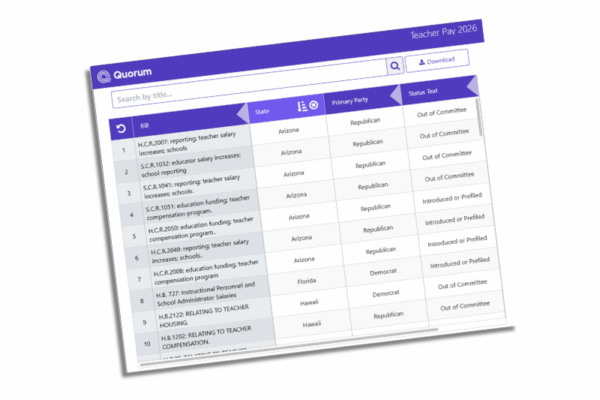
FutureEd is tracking 63 bills in 22 states that aim to boost teacher pay. Mississippi accounted for 16 of the bills—the most of any state. This surge in proposals follows a December 2025 finding by the Mississippi state auditor that the state’s average teacher salary is the lowest in the nation.
So far, one bill has been enacted:
- Indiana’s HB 1266 amends Indiana’s education code, including requiring school corporations to pay teachers with a literacy endorsement a higher salary than those without one.
Many lawmakers have proposed increasing the minimum salary for teachers. In Indiana, H.B. 1170 would raise the minimum salary from $40,000 to $60,000 per year. In Mississippi, six separate bills would increase the salary floor, which currently sits at $41,500 a year, by between $2,000 to $8,000. Minnesota’s H.F. 3119/S.F. 3490 would establish tiered minimum base salaries tied to education and experience: $60,000 for teachers without a master’s degree, $80,000 for those with a master’s, and $100,000 for teachers with a master’s degree and more than ten years of experience.
But raising the minimum salary does not always increase pay for veteran teachers, leading other state policymakers to pursue broader adjustments. North Carolina’s H.B. 932 would increase all teacher salaries by 10 percent, while Oklahoma’s H.B. 2251 would require districts to raise salaries for returning teachers by 20 percent. And in West Virginia, companion bills H.B. 4585 and S.B. 92 would give certified teachers in higher-cost areas additional pay based on local housing prices.
Other proposals take a more targeted approach, directing supplementary pay to teachers in specialized or hard-to-staff roles. Mississippi’s H.B. 1126 would pay special education teachers an additional $3,000 per year. Two bills in Pennsylvania would launch pilot programs to supplement salaries for either all pre-kindergarten teachers or specifically those teaching in Head Start programs. And Virginia’s H.B. 31 would award a $10,000 annual bonus to fully licensed teachers in high-vacancy schools.
Some lawmakers have proposed pay incentives to bring more teachers to low-performing schools. Mississippi’s H.B. 185 would make teachers in critical shortage subjects at a “D” or “F”-rated school districts eligible for an annual salary supplement of up to $15,000. Mississippi’s H.B. 158 would offer experienced teachers at higher-rated schools a $5,000 annual bonus—plus up to $1,000 in moving expenses—to transfer to an “F”-rated school in an “F”-rated school district.
Two proposals link teacher pay to student outcomes. North Carolina’s S. 599 would pay teachers $50 for each student who passes an advanced exam, $25 to $50 for each student who earns a career-technical education industry certification, and $2,000 for teachers who rank in the top 25 percent for student growth scores in early-grade reading or math. Pennsylvania’s S.B. 969 would create a Teacher Excellence Incentive Fund, providing salary supplements, bonuses, or student loan forgiveness to teachers based on measurable improvements in student performance.
Some bills do not directly raise salaries but incentivize school districts to do so. Under Missouri’s H.B. 2210, the state would match up to $1 million for districts that use their savings to increase teacher pay.
Hawaii stands out for its unique approaches to teacher compensation. S.B. 610 would give residents the option to round up their utility bills, with the additional funds directed toward teacher salaries. And H.B. 2112 would offer teachers at hard-to-staff schools housing vouchers that can be applied toward rent, mortgage payments, or a down payment on a primary residence.
We will continue to monitor and update the tracker as bills are introduced and progress through the legislative process.