Updated 7/13/2026
Tutoring is continuing to gain momentum nationwide. What began as a pandemic-era recovery strategy is increasingly being positioned as a longer-term reform, as policymakers consider how to sustain, scale, and formalize tutoring within public education systems.
In statehouses, lawmakers are advancing proposals to establish dedicated funding streams, codify high-quality tutoring in statute, integrate tutoring into required academic interventions, and pilot new delivery models, including artificial intelligence–enabled supports. At the same time, the Trump administration has elevated high-quality tutoring as a priority within competitive grant programs and recently released millions of dollars to support these efforts, underscoring continued national attention to the strategy.
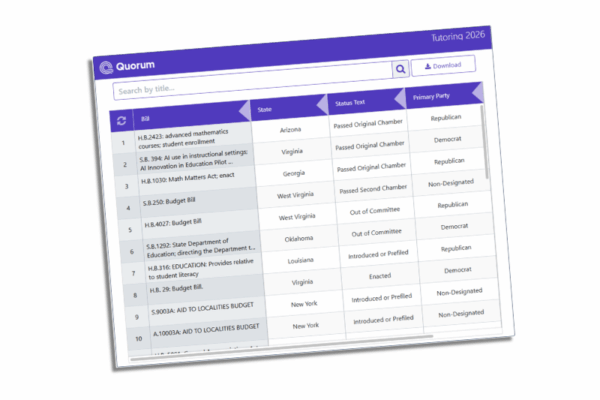
In the 2026 legislative session, FutureEd is tracking 45 bills across 20 states that reflect a growing effort to sustain tutoring as part of long-term state education systems. Many of these efforts focus on “high-impact” or “high-dosage” tutoring that research says gets the best results―programs with four or fewer students working with the same tutor for at least 30 minutes per session, three times a week, over several months.
So far, 15 bills have been enacted, including:
- Alabama H.B 238 allocates funding to a non-need-based state grant program for in-state college students and encourages participating private institutions to direct 10% of federal work-study funds toward K–12 tutoring and mentoring.
- Georgia’s H.B. 1030 requires local education agencies to provide structured supports for students enrolled in advanced math courses, including high-dosage tutoring.
- Louisiana’s appropriations bill provides $500,000 for the Family Tutoring Alliance, a new organization that will provide tutoring scholarships to public school students through the federal scholarship tax credit program. The bill also reduces funding for the state’s high-impact tutoring initiative from $30 million to $24 million.
- Massachusetts appropriated $20 million for high-dosage tutoring in its annual budget.
- New Mexico H.B. 2 provides $5 million annually for three years to support a high-impact tutoring program.
- New York’s appropriations bill includes $9 million to support Governor Kathy Hochul’s proposed initiative to provide high-impact, individualized literacy and math tutoring for students in high-need school districts.
- Virginia H.B. 29, the state’s biennial budget, appropriates $250,000 annually to EduTutorVA to provide targeted tutoring. EduTutorVA delivers high-impact virtual tutoring by trained college tutors to students in high-needs schools.
- Virginia S.B. 394 establishes an AI Innovation in Education Pilot Program to support and scale AI use in education, including tutoring.
Several states are pursuing tutoring investments through their budgets. Connecticut’s H.B. 5032 includes $5 million for high-dosage tutoring grants. Michigan H.B. 5630 would appropriate $50 million for high-impact tutoring through a competitive grant program for providers. Providers must meet research-aligned quality standards and partner with districts, with funding intended to span two years.
Other states are pursuing alternative funding mechanisms. New Jersey’s S.2591 would establish the High Efficiency Accelerated Learning Grant Program, a competitive, state-matched initiative to fund research-based tutoring programs. The bill would require the Department of Education to set performance standards and maintain a public list of qualified providers. A.1445 would create a refundable gross income tax credit of up to $500 for families who purchase high-impact tutoring services. New Jersey lawmakers are also considering additional matching grant programs.
Several states are seeking to formally define and establish high-dosage tutoring in state statute. Oklahoma is among the most active. S.B. 1292 would establish a statewide, reading-focused high-dosage tutoring program for prekindergarten through third-grade students who are at least half a grade level behind. The bill specifies three one-hour sessions per week, limits cohort size, requires regular assessment reporting, and includes performance-based tutor bonuses. S.B. 1366 would create a similar statewide, high-dosage tutoring program but would expand it to K–8 students in both math and reading. H.B. 3373 would formally define “high-dosage tutoring” in statute, specifying frequency, duration, group size, use of assessment data, and tutor qualifications, aligning state law with research-based design principles.
New Mexico lawmakers are proposing a similarly structured approach. S.B. 233 would require public schools to provide structured, high-impact tutoring to students in grades four through eight who score in the bottom quartile on statewide reading or math assessments. Tutoring would need to begin within 30 days of identification, occur at least three times per week, maintain small group sizes, and include parent notification and progress reporting.
Louisiana lawmakers are seeking to refine existing mandates. S.B. 27 would expand required participation from students in kindergarten through fifth grade to those in kindergarten through eighth grade, broaden subject-matter criteria, strengthen tutor qualification requirements, and update reporting timelines. H.B. 316 would authorize school boards to provide ongoing coaching support to tutors delivering high-dosage tutoring.
We will continue to monitor and update the tracker as new bills are introduced and progress through the legislative process.