Updated 3/23/2026
The 2026 legislative session is shaping up to be another consequential one for private school choice policy. Lawmakers across the country are proposing new programs, expanding existing ones, revising eligibility rules, and strengthening oversight.
These debates build on several years of rapid state expansion. Heading into this session, 17 states have, or soon will have, programs that make public funds available for private educational expenses to all students, regardless of income.
At the same time, states are beginning to respond to the new federal tax credit scholarship program scheduled to take effect in January 2027. Governors are beginning to opt in, while state legislatures are moving to shape how their states participate.
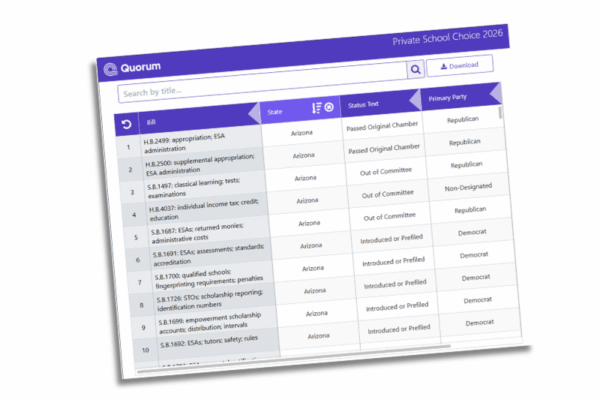
In total, FutureEd is tracking 162 private school choice bills across 28 states this 2026 session.
So far, four bills have been enacted:
- South Dakota’s S.B. 84 expands eligibility for the state’s Partners in Education Tax Credit Program by raising the income cap for participating families from 150 percent to 200 percent of the federal free- and reduced-price lunch threshold. The law also increases the maximum scholarship amount, allowing average awards to rise from 82.5 percent to 100 percent of the state’s share of the per-pupil allocation, currently around $5,000.
- Utah’s H.B. 467 tightens eligibility and strengthens oversight of the universal Utah Fits All Scholarship Program by requiring a pre-approval process for expenses, mandating audits and financial reporting, and setting customer service benchmarks, including adequate call center capacity. Participating schools must also verify financial solvency and adopt transparent tuition and refund policies.
- Utah’s S.B. 54 eliminates income-based eligibility for the Carson Smith Opportunity Scholarship Program for students with disabilities and aligns its requirements with the Utah Fits All program, standardizing definitions, oversight, and processes.
- Idaho’s H.B. 731 directs the state to participate in the federal tax credit scholarship program and requires the Department of Education to approve SGOs by January 1 each year and review applications on a rolling basis.
Other bills are continuing to move through state legislatures.
New Choice Programs
Some states are seeking to create new statewide choice programs.
- Mississippi’s H.B. 2, the Mississippi Educational Freedom Program Act of 2026, would establish a broad suite of choice, curriculum, and accountability reforms. The bill would create Magnolia Student Accounts, student portability scholarships, and education savings accounts (ESAs) for students with special needs. All students would be eligible for the Magnolia accounts, with half of awards reserved for students who previously attended public school. Awards would be prioritized by income, beginning with students from families at or below 100 percent of the area median income. The program would launch in 2027–28 and be capped at 12,500 participants in its first year, with planned growth in subsequent years. Award amounts would vary by enrollment status: students attending participating private schools would receive the state per-pupil allocation; students enrolled in nonparticipating private schools would be eligible for up to $2,000, subject to a $4,000 household cap; and homeschool students would be eligible for up to $1,000 per household. Mississippi is currently one of the few Southern Republican-led states without a universal private school choice program.
- Iowa’s H.F. 2078 would create a $4,000 refundable tax credit for any taxpayer with dependents who are switching from public school to private or home school, or entering kindergarten outside the public system, provided they are not already receiving ESA funds. The bill would also establish a dedicated fund to issue advance payments and would apply retroactively to January 1, 2026.
Other states are pursuing programs more narrowly focused on low-income students, students in under-performing public schools, or those with specific educational needs.
- Maryland’s H.B. 1204 would establish a Maryland Education Savings Account program for students who attended a public, charter, or home school in the prior fiscal year, as well as children of active-duty military members stationed in the state. Awards would be income-based, with families at or below 500 percent of the federal poverty level receiving 75 percent of the per-pupil state and local funding amount and families above that threshold receiving 50 percent.
- In New Jersey, S. 1027/A. 1578, the Opportunity Scholarship Act, would create a five-year pilot offering tax credits to individuals and corporations that contribute to a designated scholarship organization, with scholarships targeted to low-income students in or eligible to attend chronically failing schools in eight districts.
- Rhode Island lawmakers are weighing S.B. 2540, which would establish an Education Freedom Account program for students with household incomes at or below 250 percent of the federal poverty level.
- Washington’s H.B. 2719 would establish the empowerED scholarship program, providing ESAs for students in foster care.
West Virginia is proposing alternative approaches, including H.B. 4611, which would allow parents at small public schools to convert them into Public Community Micro Schools whose students would become eligible for universal ESAs, and H.B. 4914, which would require that if the federal government returns education funding to the state as unrestricted block grants, those funds be deposited into ESAs for students statewide.
Expanding Existing Programs
In addition to creating new programs, many states are seeking to expand existing ones by increasing caps, removing enrollment limits, or broadening eligibility.
- New Hampshire’s S.B. 581 would eliminate enrollment caps and priority guidelines in the state’s universally eligible Education Freedom Account program, allowing full universal, unlimited participation beginning July 1, 2026.
- In Tennessee, companion bills S.B. 2247/H.B. 2532 would raise the cap on the state’s universal ESA program from 25,000 to 40,000 scholarships for 2026–27 and require state participation in the federal tax credit scholarship program.
- Missouri’s S.B. 998 would loosen eligibility requirements by eliminating prior public-school attendance and grade-level entry conditions for income-eligible students and expand disability eligibility. It would also prohibit accreditation requirements for participating private schools.
- Oklahoma’s S.B. 1389 would create automatic increases to the universal tax credit cap, raising it by 20 percent in subsequent years if at least 90 percent of the existing $250 million cap is claimed.
Strengthening Oversight and Accountability
Lawmakers across parties are also advancing measures to strengthen oversight, particularly in universal programs.
- In Tennessee, S.B. 1978/H.B. 1889 would strengthen oversight of the state’s universal ESA program by adding audit requirements, expanding public reporting, requiring participating students to take standardized tests aligned to state assessments, mandating twice-annual written progress reports to parents, and limiting tuition increases at participating schools to 10 percent annually, among other changes.
- Iowa’s H.F. 2172 would allow ESA students to take either state assessments or nationally norm-referenced exams (as opposed to just the state assessment), while S.F. 2008 would subject nonpublic schools receiving ESA funds to the same accountability and auditing standards as public schools.
- In Arizona, S.B. 1691, S.B. 1692, and H.B. 4052 would require state assessments, align curricula with state standards, establish new safety requirements, and strengthen quarterly reporting.
- Florida’s S.B. 318 would overhaul the state’s scholarship programs by creating a dedicated categorical funding stream for the Family Empowerment Scholarship, adding $250 million to cover cost overruns, and expanding the Florida Department of Education’s authority to verify eligibility and investigate fraud. The bill would strengthen oversight of scholarship funding organizations through enhanced audit and reporting requirements, require eligibility cross-checks before payments are disbursed and standardize student tracking and withdrawal processes to reduce improper payments, and impose new compliance requirements on participating schools.
- Louisiana’s H.B. 186 would go a step further by creating criminal penalties for intentional misuse of funds in the universal LA GATOR Scholarship Program.
Virginia’s H.B. 359 takes a slightly different approach. Rather than targeting a specific program, the bill would establish a comprehensive regulatory framework for any private school receiving public tuition assistance—whether through a state or federal initiative. The proposed framework would require participation in state assessments, adherence to nondiscrimination protections, compliance with accreditation standards, regular financial audits, teacher credentialing requirements, and civil penalties for noncompliance.
Scaling Back or Repealing Programs
In some states, lawmakers are seeking to scale back programs.
- Ohio’s H.B. 643 would impose a $500,000 adjusted gross income cap on EdChoice expansion eligibility, which currently has no income requirement.
- West Virginia’s H.B. 4961 would add a $150,000 income cap to the Hope Scholarship program.
- Oklahoma’s S.B. 1391 would lower priority income thresholds for the universal tax credit from $150,000 to $75,000 and add assessment requirements for participating private schools.
Other proposals would repeal programs altogether, including Iowa’s S.F. 2321, Oklahoma’s H.B. 3684 and H.B. 2953, and Tennessee’s H.B. 1740/S.B. 1975.
Federal Tax Credit Scholarship Responses
Perhaps the most significant new development this session is the wave of legislation responding to the forthcoming federal tax credit scholarship program. Under current federal law, participation is initiated by a governor (or designated state official) who must formally opt in by submitting a list of approved scholarship granting organizations (SGOs).
Some states are urging their governors to participate through resolutions, including New Jersey’s SR 20 and Washington’s HJM 4013.
Others are advancing legislation to facilitate or require participation.
- Maryland’s S.B. 329 would require the State Department of Education to certify SGOs annually and submit a list to the U.S. Secretary of the Treasury, while directing the state’s Comptroller to publish taxpayer guidance.
- Georgia’s S.B. 446 would align state law with federal requirements and establish permanent participation in the program, which Governor Brian Kemp has already elected to join. The bill would designate the Department of Revenue as the agency responsible for administering the program.
- West Virginia’s S.B. 644 would require the state treasurer to opt into the program, select qualifying SGOs, and administer participation at the state level.
Conversely, some states are seeking to prohibit participation.
- Illinois’ S.B. 3966 would bar the state from participating in any federal voucher or ESA program.
- In Vermont, H.770 would designate the General Assembly as the sole authority to make an election regarding participation and would prohibit participation.
The extent of state legislative authority to regulate states’ involvement in the federal program remains uncertain. While governors (or designated officials) are responsible for formally electing participation under the federal law creating the scholarship program, legislation affecting that authority would generally require gubernatorial approval unless enacted over a veto. Forthcoming federal regulations are likely to play a major role in determining participation questions and whether legislatures can permanently mandate or prohibit participation.
We will continue to monitor and update the tracker as new bills are introduced and progress through the legislative process.