Updated 3/27/2026
Policies targeting chronic absenteeism continue to circulate in state legislatures this year. Defined as missing 10 percent or more of school days in a school year for any reason—excused or unexcused—chronic absenteeism differs from truancy, which focuses specifically on unexcused absences and often carries legal consequences for students and their families.
While attendance is ultimately managed at the local level, states have taken an increasingly active role in addressing chronic absenteeism since the pandemic. In the 2021-22 school year, chronic absenteeism peaked at nearly 30 percent nationally and, despite gradual improvement, remains well-above pre-pandemic levels.
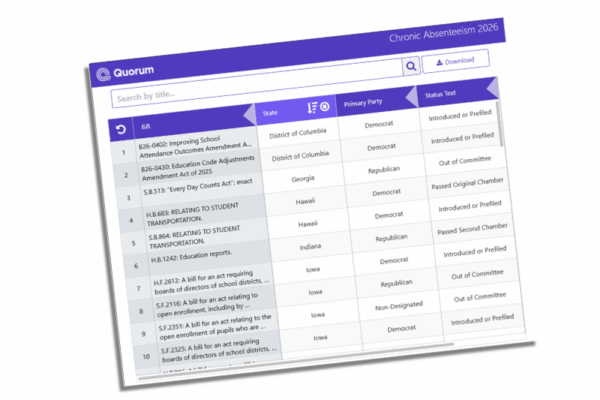
FutureEd has identified 66 bills across 22 states and the District of Columbia this legislative session that address chronic absenteeism. This scan also includes legislation related to truancy, particularly where proposed changes signal shifts in disciplinary approaches.
So far this session, two bills have been enacted, including:
- New Jersey’s A. 1733, which establishes a chronic absenteeism task force to analyze attendance data, identify root causes, evaluate the impact of other school policies on absenteeism, and issue a final report with recommendations to reduce absenteeism.
- Utah’s S.B. 58, which creates accountability measures requiring local education agencies to implement comprehensive student attendance monitoring and chronic absenteeism supports.
Other bills are continuing to move through state legislatures.
Several states are proposing intervention systems that would support chronically absent students. In Mississippi, S.B. 2506 would require the state board of education to adopt rules requiring the use of evidence-based interventions for students vulnerable to chronic absences, as well as for schools and school districts with high absenteeism rates.
A common strategy under consideration is the use of attendance review teams. New Jersey’s S. 294 would require high-absenteeism school districts to form teams of educators, administrators, counselors, and community representatives, who will review cases and recommend interventions. New York’s S. 8528 would fund a three-year pilot in 15 large districts, with teams working directly with chronically absent students to assess root causes and develop re-engagement plans. And in Georgia, S.B. 513, the “Every Day Counts Act,” would prohibit chronically absent students from participating in extracurricular and interscholastic activities until they and their guardians meet with a review team.
New York’s A. 10239 is a particularly comprehensive bill that signals a shift away from punitive approaches. It would incorporate early warning systems to identify students at-risk of being chronically absent, create attendance review teams in schools and school districts with high absenteeism, and prohibit the arrest of truant students.
Several states are also working to promote transparency in attendance data. Utah’s H.B. 106 and New York’s S. 8526 would require disaggregated student attendance data through a public dashboard. Utah’s data would be published by the state board of education and updated annually, and New York’s would be maintained by the state department of education and updated at least weekly, also including year-over-year comparisons and data visualizations. A lack of timely attendance data has been a barrier to addressing chronic absenteeism in many states.
Other proposals would target structural barriers that contribute to absenteeism. Utah’s H.B. 106 would pair enhanced data transparency with a state-commissioned study to identify the root causes of chronic absenteeism. New Mexico’s H.M. 58 would call for a study of how transportation access affects attendance, while Hawaii’s S.B. 864 would create student transportation coordinator positions to address the state’s school bus driver shortage, which lawmakers link to decreased attendance.
States are also reconsidering the consequences tied to truancy. In West Virginia, H.B. 4656 would shift away from criminal penalties for truant students, emphasizing early intervention, school-based supports, family engagement, and community services. Other states are taking a more enforcement-oriented approach: Missouri’s H.B. 2533, for example, would require school districts to meet with parents after a set number of unexcused absences and to report noncompliance to the state’s child welfare agency, potentially triggering a home visit and legal consequences. Mississippi’s H.B. 225 would mandate drug testing for public school students in grades 6 to 12 who are truant.
We will continue to monitor and update the tracker as new bills are introduced and move through the legislative process.