
Updated 7/13/2026
Student nutrition and school meals have emerged as a growing focus for governors and state lawmakers in 2026. Across the country, policymakers are advancing a wide range of strategies—from tightening restrictions on ingredients like artificial dyes and ultra-processed foods, to promoting locally sourced food through farm-to-school initiatives, to expanding eligibility for free and reduced-price meals.
This activity builds on a long-standing, bipartisan policy area shaped in part by federal action. The Healthy, Hunger-Free Kids Act, championed by Michelle Obama in 2010, strengthened national school nutrition standards. And more recently, student nutrition has received renewed attention through broader public health efforts, including the “Make America Healthy Again” initiative spearheaded by the Trump administration under the leadership of Secretary of Health and Human Services Robert F. Kennedy Jr.
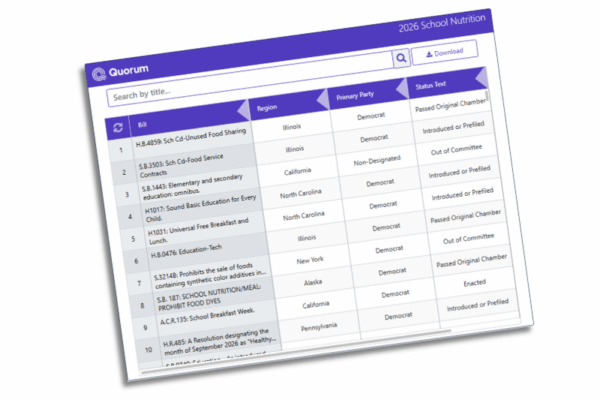
In total, FutureEd is tracking 192 student nutrition and school meal bills across 41 state legislative sessions this year.
Thus far, 27 bills have been enacted, reflecting a mix of approaches spanning nutrition standards, access to school feeding programs, funding for new and continuing health initiatives, and procurement of locally produced food. These include:
- West Virginia H.B. 4982 reestablishes and expands the state’s Healthy Lifestyles Program, including a farm-to-school initiative to serve locally grown produce in school cafeterias and reporting requirements tied to U.S. Department of Agriculture school nutrition standards and fruit and vegetable offerings.
- Delaware S.B. 69 prohibits schools from selling or serving foods containing Red No. 40 during the school day, including in vending machines.
- Tennessee S.B. 2423/H.B. 1853 builds on previous efforts by expanding an existing ban on Red No. 40 to all artificial food dyes in school meals.
- Nebraska L.B. 940 bans the inclusion of six artificial food dyes (Blue No. 1, Blue No. 2, Green No. 3, Red No. 40, Yellow No. 5, and Yellow No. 6) in federal school meal programs.
- Kentucky S.B. 5 encourages districts participating in federal child nutrition programs to prioritize Kentucky-grown products and creates exemptions in the procurement and bidding procedures.
- Washington H.B. 2594 expands access by requiring that homeless students be provided school meals and directing the state to develop an implementation plan for achieving that goal.
- Colorado H.B. 26-1153 increases school meal reimbursements by more than $35 million, shifting funding from the State Education Fund to the Healthy School Meals for All Program Fund.
- Utah H.B. 36 establishes the Gold Medal Schools Pilot Program to promote healthy eating, physical activity, and overall student well-being.
- Virginia H.B. 1086 adjusts procurement rules to give in-state food manufacturers a competitive advantage by allowing them to match the lowest out-of-state bids.
- Nebraska L.B. 966 establishes a pilot program to expand the provision of free school meals to students who previously only qualified for reduced-price lunch.
- Iowa H.F. 2676 prohibits schools from serving or selling foods containing certain artificial dyes and additives.
States are also considering a range of additional proposals.
A large share of legislation this session focuses on improving the nutritional quality of school meals, with states moving toward more prescriptive standards. Several states—including Vermont (S. 26), Alaska (S.S. 187), and Iowa (H.F. 2676)—are advancing proposals that would ban artificial dyes such as Red No. 40 and Yellow No. 5 in schools, often alongside other additives and preservatives like potassium bromate and propylparaben. Some states are going further by regulating broader nutritional composition. For example, West Virginia’s S.B. 745 would cap added sugar and require minimum fiber ratios in school meals.
At the same time, states are beginning to define and regulate ultra-processed foods in schools. Proposals in New Jersey (S. 946), Kentucky (H.B. 277), and South Carolina (H.B. 4339) would implement ingredient-based definitions tied to specific additives and dyes. Kentucky’s bill would prohibit such foods in all schools, New Jersey’s would apply to schools participating in federally funded meal programs, and South Carolina’s would exclude charter schools. West Virginia’s H.B. 5481 would pair a broader definition of ultra-processed foods spanning both ingredients and preparation methods with phased implementation timelines, technical assistance for districts, and waivers where access to compliant food is limited. Meanwhile, Illinois’s H.B. 5507 would take a more expansive approach by requiring districts to eliminate foods high in saturated fat, sodium, or added sugar at their own expense and mandating detailed reporting for vendors supplying school food.
Beyond restricting certain ingredients, states are seeking to reshape what schools are expected to offer. Several proposals aim to expand dietary options and accommodate student needs, including legislation in New Jersey (S. 1676) and West Virginia (H.B. 4871) that would require schools to provide plant-based alternatives upon request, and a Massachusetts bill (S. 2927) that would mandate accessible information for students with medically restricted diets such as celiac disease.
Many states are also advancing initiatives to promote locally sourced food by aligning school meal policy with broader economic and agricultural goals. Farm-to-school programs are a central strategy, with Massachusetts (S. 3029/S. 3040, H. 565) and Kentucky (H.B. 871) proposing grant and reimbursement programs to support schools in purchasing in-state agricultural products. Other states, including New Jersey (A. 2513, A. 4754) and Illinois (H.B.5591), are prioritizing local and regional vendors through procurement preferences, while Washington (H.B. 2369) and Vermont (S. 323) are focused on building the underlying strategies, like contract enforcement and centralized distribution, to make local sourcing more feasible at scale.
States are revisiting eligibility for free and reduced-price meals as well, with many proposals promoting broader access. Several states—including Rhode Island (H.B. 8166, H.B. 7793, S.B. 2083, S.B. 2663) and New Jersey (A. 3871)—are advancing phased-in universal meal programs, while others such as Missouri (H.B. 3121), Florida (S.B. 1098), Tennessee (S.B. 1809), and North Carolina (H. 1031) propose offering free meals to all students statewide. Additional legislation in Oklahoma (S.B. 1374) and Utah (S.B. 180) would expand eligibility thresholds to include more middle-income families who do not currently qualify for federal assistance. Utah’s bill would fund this expansion using state liquor revenue. And in Mississippi, H.B. 820 would require all schools or districts with at least 25 percent of students receiving free lunch to apply for federal programs that would provide free meals to all students.
But not all states are moving in the same direction. Minnesota (H.F. 3511/S.F. 3925) would scale back its existing universal program by introducing an income cap, limiting eligibility to families at or below 500 percent of the federal poverty guidelines.
Policymakers are also addressing student food access over the summer when school is not in session. Oklahoma’s H.B. 3638 would require statewide participation in the federal Summer EBT program, while West Virginia’s S.B. 102/H.B. 4777 would expand efforts to increase participation in the state’s summer feeding program. Other states, such as Iowa (F. 2676) and Kansas (S.B. 315), are seeking to exclude unhealthy food like candy and soft drinks from Summer EBT programs.
We will continue to monitor and update the tracker as bills are introduced and progress through the legislative process.